


A Grand Park Tradition: Grandparents' and Special Friends' Day

Here is a snapshot of what our students have been up to this fall across classrooms and the library.
Pre Kindergarten students in Stella Billek and Harriet Matthews’ classroom are diving into autumn by connecting outdoor playtime with their natural curiosity about seasonal changes, exploring questions like why leaves and acorns fall. Each week focuses on a different seasonal element. This week centers on wildlife spotted around campus, driven by the children's fascination with chipmunks and the playground holes they dig. Recent lessons cover owls, bears, and seasonal animal behaviors.
Since Tuesdays feature an extended block of time, teachers are introducing a weekly craft. This week, students made unique owl crafts by tearing paper and attaching pieces to a pre-cut owl body, an activity designed to build fine motor skills and practice executive functioning as students follow step-by-step instructions.
To balance sit-down activities like storytime and rest time, teachers gauge student energy and insert 5-minute movement videos or activities, such as Salamander Yoga, to help kids refocus and manage their energy.
Ms. Matthews read Owl Babies by Martin Waddell to the class. Before beginning, students reflected on personal connections through a gentle prompt to put a thumb to their heart if someone at home takes care of them, whisper that name, and throw it into the center of the group. During the read-aloud, Ms. Matthews paused to ask students how the baby owls were feeling and encouraged students to interpret the characters' emotions. Following storytime, students always connect the reading to their own lives through art, with this session's drawing prompt asking them to draw someone who takes care of them.

After recess and lunch, Grade 2 turned their attention to literacy and character analysis. Students engaged in whichever setup felt most comfortable to them,some pulled up cushions to sit right on the rug in front of Grade 2 Teacher, Peter Bown, while others listened and worked from their desks.
The lesson centered on analyzing distinct character traits through various versions of "Cinderella" stories, comparing Cinderella’s demeanor to that of her stepmother and stepsisters.
To go beyond basic descriptions, Mr. Bown encouraged the class to find text evidence and explore richer synonyms. When students described Cinderella as "kind," the discussion expanded to include nuanced vocabulary like "genuine," "hardworking," and "humble." Conversely, when analyzing the stepmother and stepsisters, the class moved past simple words like "mean" to introduce sharp, descriptive traits such as "deceitful," "arrogant," "crafty," "sneaky," and "cruel." Students thoughtfully defined these terms in their own words, with classmates stepping in supportively whenever someone needed help completing a thought.
By examining multicultural retellings, including Yeh-Shen: A Cinderella Story from China, by Ai-Ling Loui, The Rough-Face Girl, by Rafe Martin, Cinderella: An Islamic Tale, by Fawzia Gilani-Williams, Mufaro’s Beautiful Daughters, by John Steptoe, and Cendrillon: A Caribbean Cinderella, by Robert D. San Souci, the class observed how different stories contrast opposing personalities.
"There is always a character that is completely opposite," one student noted.
This sparked a lively discussion on traits like "arrogant," as students brainstormed what arrogant or deceitful characters might say, do, or think about themselves relative to others. Then, they transitioned into exploring the overall lessons and morals of the fairy tales.

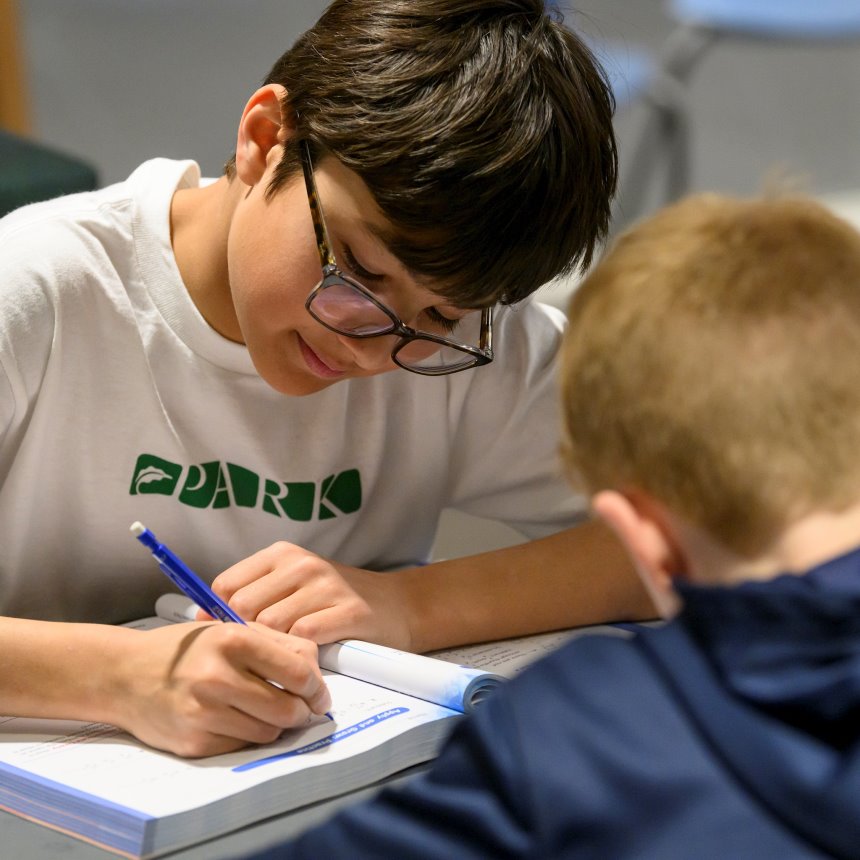
Fourth graders are diving into data collection and analysis through hands-on, real-world applications in Isa Moss’ classroom. Building on last Friday’s activity, where students measured first-grade jumping distances to learn the fundamentals of data collection, the fourth graders measured their own jump distances to establish a second dataset. Next, students will construct graphs to compare the two datasets, experimenting with different visual representations to discover the underlying story the numbers reveal.
In addition to analyzing their own measurements, students will be exploring 2026 WNBA player statistics to determine ideal team rosters. A streamlined version of this task centers on evaluating total points scored to help students understand how specific metrics inform strategic team-building decisions. While students analyze individual point metrics independently, they collaborate in teams to construct graphs and interpret larger datasets. As Ms. Moss highlights, this annual Grade 4 tradition helps make data meaningful by showing students how organizing and interpreting information puts real-world data into a clear, useful perspective.
Throughout this unit, students are practicing foundational data skills like selecting appropriate scales, identifying ranges, and backing up their decisions with numerical evidence. Whether justifying a WNBA player pick based on scoring statistics or explaining differences in jumping distances, students are challenged to explain the "why" behind the numbers. Working together in teams to process larger datasets encourages math communication and critical thinking, reinforcing the idea that math is not just about calculation, but about solving problems and making informed decisions.

As Rachel Ann Mencke, Director of Park's library, shares, "The library is a hub for exchanging information, finding the things you are interested in, and sharing that," and stepping inside instantly reflects that vision.
A new display featuring mildly spooky, unsolved nonfiction mysteries—from Bigfoot to UFOs—is up for the season, alongside a celebration display for the upcoming festival of Diwali.
Beyond books, the library's "Library of Experience" kits have been circulating like crazy. These hands-on "Experience in a Box" sets allow students to dive directly into interactive learning, featuring things like:
These portable kits ensure students get hands-on opportunities to expand their know-how. Other popular interactive activities include making friendship bracelets, learning self-taught crochet, and learning classic games like jacks, cat’s cradle, and hand-clapping games. While lower division students are currently the most active users, the goal is to keep expanding these opportunities across all grades.

By Emma Hobart-Sheran, Assistant Director of Marketing and Communications
#TheParkSchoolMA #ParkSchoolExcellence #ItAllStartsatPark #ParkSchoolFaculty #ParkSchoolCommunity


