.jpg?command_1=resize&width_1=860&height_1=860)
Head’s Lines: Finding Joy in Challenge

It’s Model United Nations—one of Park’s most dynamic Upper School offerings—and a powerful example of what it means to Achieve with Integrity.
Led by faculty member Lisa DiAdamo, Park’s Model UN program invites students in Grades 6–8 to engage deeply with the world around them. Grade 6 begins with an on-campus conference centered on a shared topic—this year, access to clean water—while seventh and eighth graders can choose from four to six off-campus conferences throughout the year. Hosted by organizations like the United Nations Association of Greater Boston (UNAGB) and schools such as Boston University Academy and Commonwealth School, these conferences bring together students from across the region for rigorous, real-world problem-solving.
Participation is both enthusiastic and widespread. More than 30 Grade 6 students take part in Model UN each year, and nearly half—if not more—choose to attend a conference. In Grades 7 and 8, approximately 40 Park students participate in each conference, with sign-ups often filling within an hour.
But Model UN is about far more than numbers. It’s about learning how to think—carefully, critically, and compassionately.
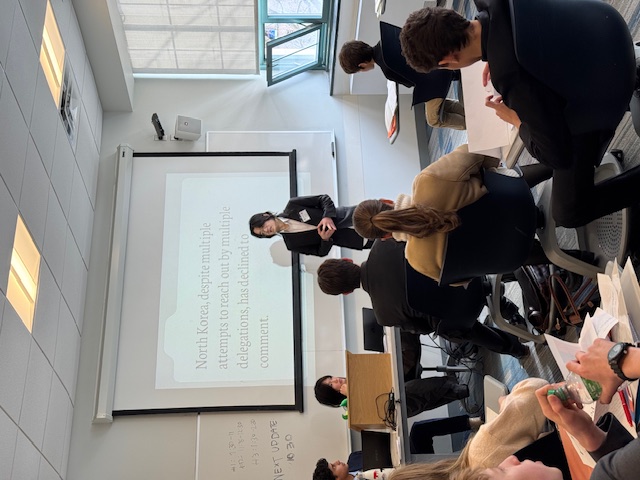
Students begin by researching complex global issues, from climate change and gender inequality in education to the economic realities of the wage gap or political instability in regions like the Democratic Republic of the Congo. They learn to analyze how these challenges play out both locally and globally, and to understand the perspectives of the countries they represent. At conferences, students deliver opening speeches, collaborate in small groups, draft and revise resolutions, and ultimately advocate for solutions they believe in.
“It’s an intellectual community,” Lisa explains. “Students come together because they want to grapple with real-world problems and think about how to solve them.”
That sense of purpose is matched by a strong emphasis on integrity. In Model UN, there is no single “right” answer. Instead, students are challenged to consider multiple viewpoints, listen actively, and engage respectfully—even when opinions differ. “Integrity allows for different perspectives,” Lisa says. “Students learn to look at issues through many lenses, not just their own.”
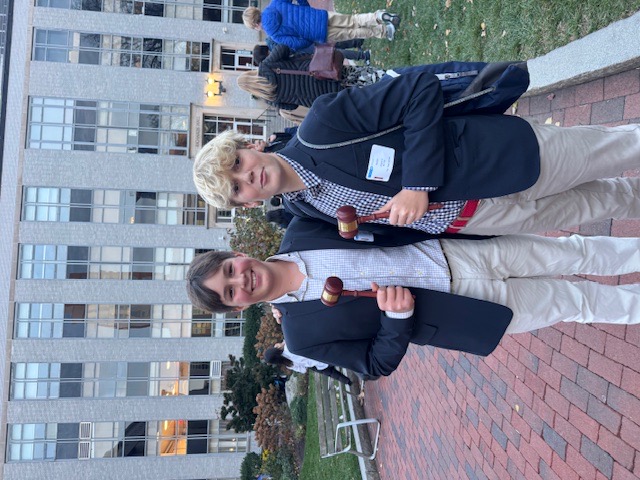
The results are impressive. Park students are frequent award winners, earning recognition for Best Position Paper, Public Speaking, Honorable Mention, and Best Delegate—the highest honor, symbolized by a gavel. But just as meaningful are the skills they develop along the way: debate, collaboration, writing, and confident self-expression.
Student leaders help guide the program, modeling both excellence and enthusiasm for younger participants. And behind the scenes, the program continues to grow thanks to student initiative. In recent years, Grade 8 students themselves advocated for expanded faculty support, helping to strengthen and sustain the program for those who follow.
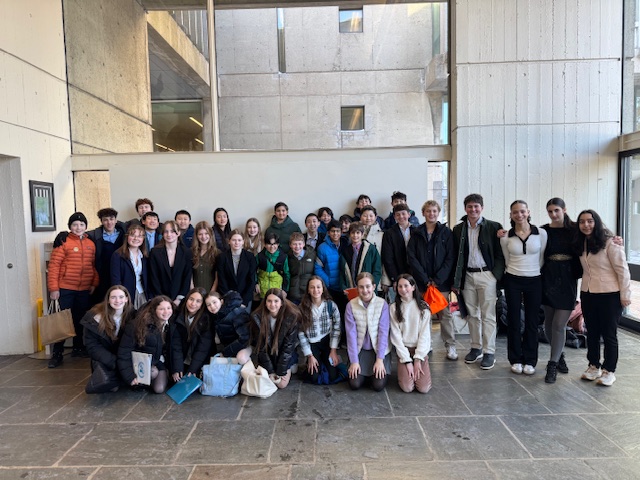
Preparation happens during weekly Friday meetings and occasional Sunday sessions, where students refine their position papers and presentations. Conferences themselves are immersive, often held in large university spaces where students navigate not only the intellectual demands of the day, but also the independence of being in a new environment—ordering lunch, managing time, and connecting with peers from other schools.
Park also has the unique opportunity to host its own Grade 6 conference, with guidance from UNAGB leaders who teach parliamentary procedure and return to serve as judges. It’s one more way students experience both the structure and excitement of global diplomacy.
For Lisa, one of the most rewarding aspects of Model UN is how much she learns from her students. “They are incredibly thoughtful,” she says. “Their determination, their willingness to consider different perspectives—it’s inspiring.”
By Emma Hobart-Sheran, Assistant Director of Marketing and Communications
#TheParkSchoolMA #ParkSchoolExcellence #ItAllStartsatPark #ParkSchoolCommunity


_11zon.jpg&command_2=resize&height_2=85 "Small Ideas that Build Something Special")