.jpg?command_1=resize&width_1=860&height_1=860)

Head’s Lines: Finding Joy in Challenge
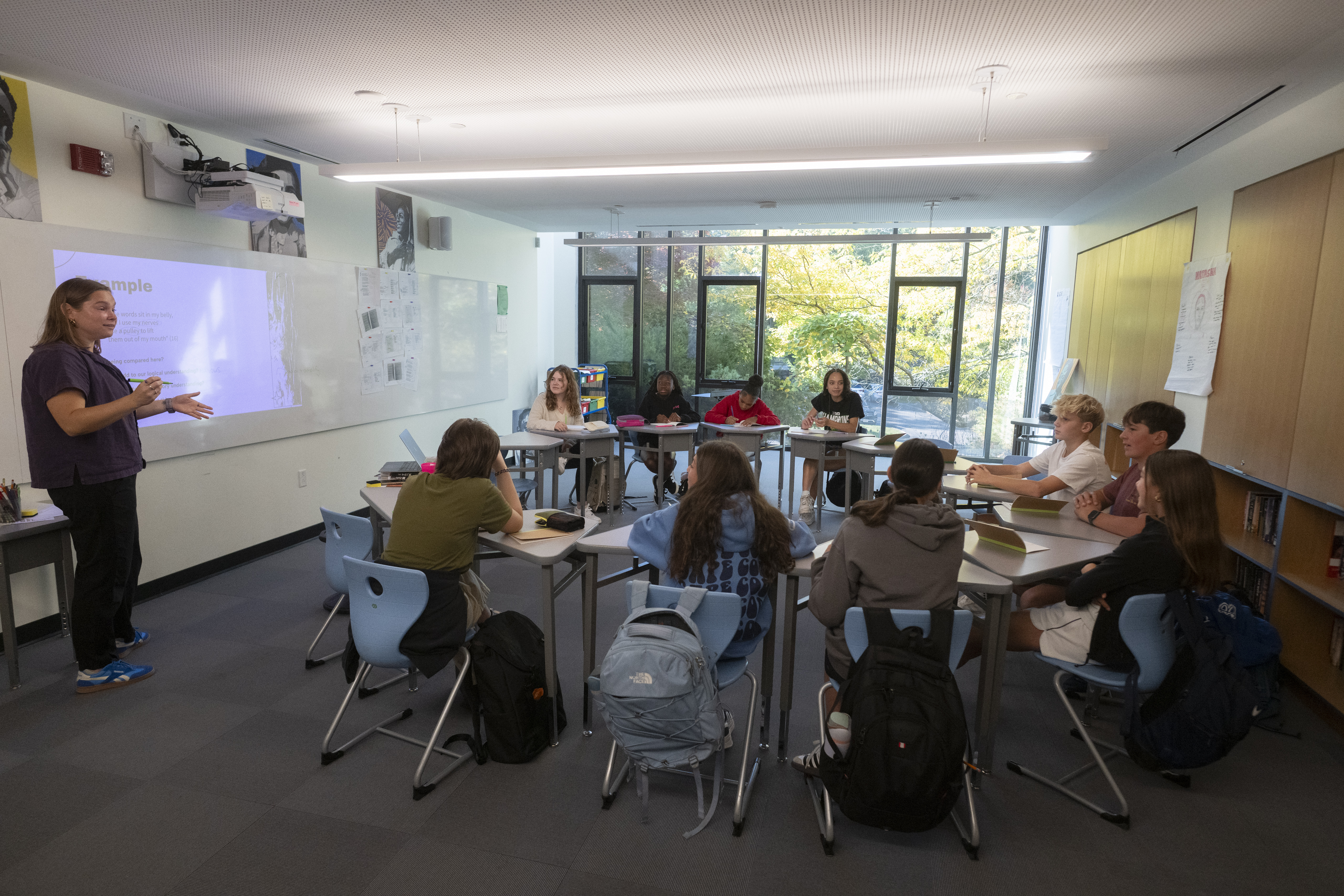
Students encounter poetry as both readers and writers throughout their journey in the Lower Division. When they reach the Upper Division, poetry is an important part of the curriculum in every grade, according to English Department Chair Lauren Dennis.
In Grades 5 and 6, students experience what Lauren describes as a “poetry sampling.” They study and write poetry and learn to appreciate how poetry includes features such as figurative language and sensory details. They read several novels in verse, which have been a newer way to incorporate more poetry into the curriculum. In Grade 6, students participate in the “Poetry Olympics,” in which they practice writing poems in various formats or in the style of famous poets. Over the years, the Poetry Olympics have included writing odes to commonplace objects, “soul poems” to practice using extended metaphors, and "I Am the Greatest" poems inspired by Muhammad Ali.
The Blossoming Hydrangea
My soul is a sweet hydrangea.
Pastel purple, pink, and blue.
Bright, fragrant, and delicate.
I am always excited, shiny, clean, and very precious to my parents.
I am treated with care and I am kind.
The hydrangeas in my backyard are clover-shaped,
looking like other world objects.
Hydrangeas are what make air taste fresh like that lovely pink apple in spring.
Gorgeous and Colorful.
I am like that too
when l awaken to a vibrant sunshine.
That's when my beautiful day of glory begins.
I am a flower pretty in spring, but in hibernation season
I become a little snowy and wilted.
Hydrangeas are resilient like me and they endure the cold snow.
They won't stop trying to grow again.
I am persevering and trying hard with everything, I won't stop until l achieve.
Hydrangeas are very nice to see just like me.
I am as strong as a Hydrangea.
In Grade 7, students shift to using poetry as a way to react to other styles of writing. For instance, they might rewrite a scene in poetry or write a poem from a particular character’s perspective. In conjunction with reading Jason Reynolds’ novel Look Both Ways, students write personal poems about places of meaning to them. As in Grades 5 and 6, Lauren explains, poetry provides a “huge benefit” to students’ analytical thinking and strengthens their writing in other genres.
In Grade 8, students culminate their study of poetry with a memorable project that is a Park tradition stretching back decades: creating a personal poetry anthology. Over the course of six weeks, students read around one hundred poems, taking advantage of a huge cart filled with poetry collections that their teachers have curated for them. Students excitedly share poems and ideas with their classmates as they narrow down the poems they have read to about ten that feel particularly meaningful to them. For each poem they choose to include in their anthology, students prepare an explication that could take the form of a biography of the poet, a close reading, or an original poem in response to the poem under consideration. The collection that students create is “so personal and so special,” says Lauren. She posits that the anthologies are such clear reflections of each student that other students (and teachers!) would know exactly whose anthology they were reading even if it weren’t labeled with the author’s name.
Who I Am
My soul
is a tree in a rainforest
as crowded as a colorful painting
every unique color swirling around
that's what I want around my family
even if we're not related
we're still family in the same crowded
lush, green
warm
friendly
rainforest
and I'll never leave
I'll never leave the whispering wind
or the swaying trees the wet soil
everyone
I'II never leave
Each anthology is tied together by a theme and includes original illustrations for every poem along with a dedication, table of contents, and introduction, leading it to feel like a professional publication. On the last morning of the school year, Grade 8 families gather for a celebration at which all students’ anthologies are on display. Our Grade 8 English teachers lift one line from each student’s anthology in order to create an original poem for each section, and they read these poems aloud to the assembled students and families as an eloquent capstone to the year.
Lauren notes that poetry also finds its way into student life outside of the classroom. The school sponsors several small poetry competitions during the year, including one in which students can compose original poems on an assigned theme and compete for a chance to read their work aloud at Yule Fest. This month, students will enjoy two poetry-related visits from Park alumni. Sawyer A. ’25 published two collections of poetry over the past year, tiny suns in sidewalk cracks and saltwater. Sawyer will share some poems and talk about the process of writing, editing, and publishing the collections. Sisters Alissa ’25 and Maya ’18 R. will also visit the Upper Division during an upcoming Morning Meeting to share information about the New England Children’s Poetry Competition, an annual contest they founded. Finally, the Park Anthology, published at the end of the school year, includes many original student poems (in addition to artwork and writing in other genres), and serves as a rewarding way for students from throughout the school to share their work with the rest of the community.
- Elizabeth Prasse, P’27, ’29, Park Perspectives Co-Editor
#TheParkSchoolMA #ParkSchoolExcellence #ItAllStartsatPark #ParkSchoolCommunity
Listen to Upper Division students reading "Everyday Odes: A Look at Poetry in Park’s Upper Division," here!


_11zon.jpg&command_2=resize&height_2=85 "Small Ideas that Build Something Special")