.jpg?command_1=resize&width_1=860&height_1=860)
Head’s Lines: Finding Joy in Challenge
All over campus, students work with buddies from other grades on an array of improvement projects.
Up at the flower beds by The Shed, Kindergarteners and Grade 5 students plant scallions, purple kale, and snap peas. Down by Pre-K, the littlest Park students rake with their Grade 4 partners. Near the turf field, Grade 8 and Grade 3 students transfer echinacea from plastic pots into a strip of mulch.
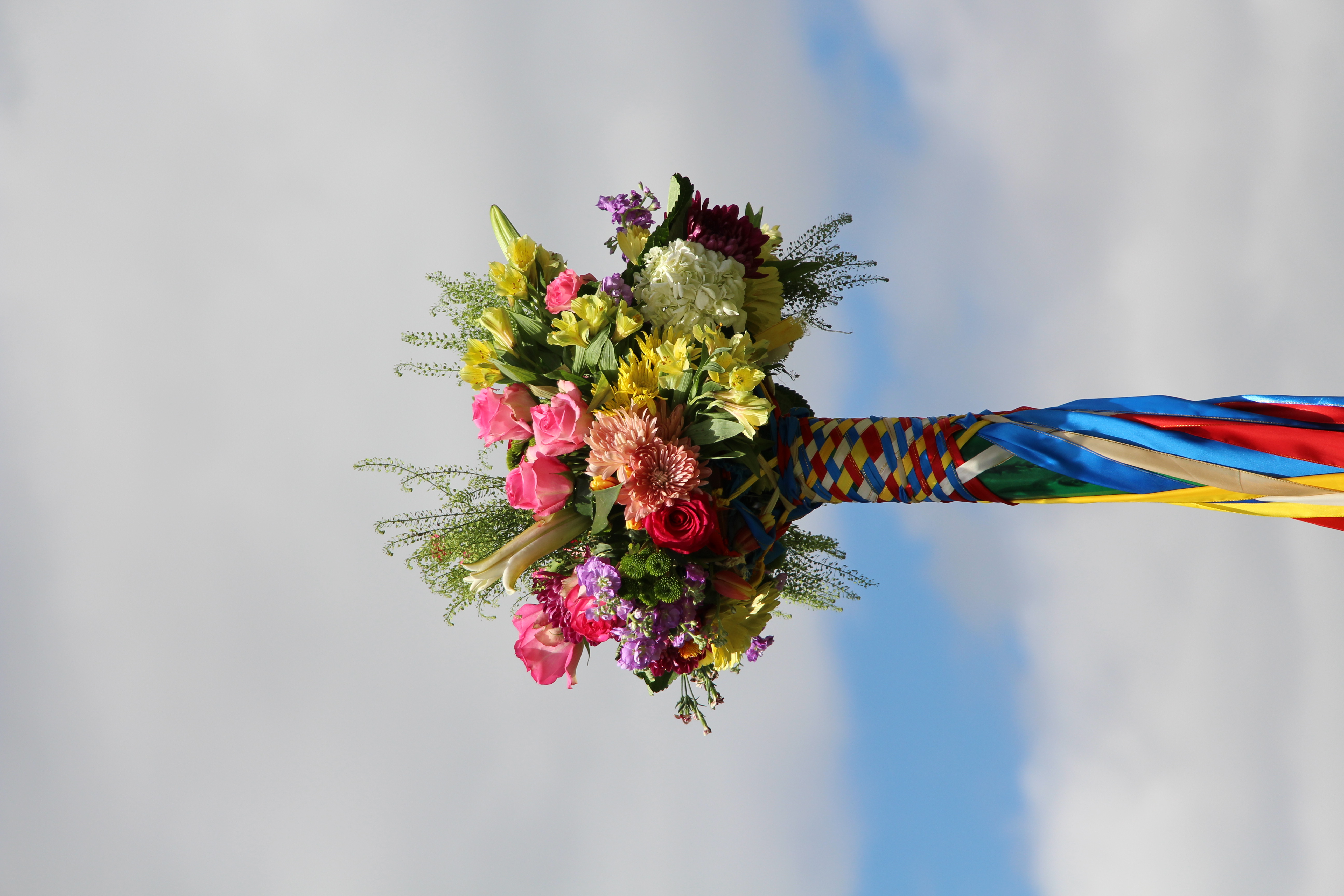
In the distance, a metal pole topped with a crown of flowers is erected in the main field. Strands of colorful ribbons cascade out from beneath the floral topper, rippling in the breeze. A guitar strums a few cords in a sound check.
This flurry of, perhaps seemingly disparate, activities is all part of that annual Park rite of passage known as May Day.
.png)
Watch a video of the Grade 1/Grade 6 May Day buddy collaboration. Video by Madison Morini.
A storied tradition
With roots dating back to the early 1900s, May Day at Park was, for many years, primarily a recital event for the lower division. Each grade was assigned a song, with everyone joining in for a few English traditional tunes, such as “The May Day Carol,” and “Unite, Unite”—one verse of which Head of School Robert Hulburt would belt out solo.
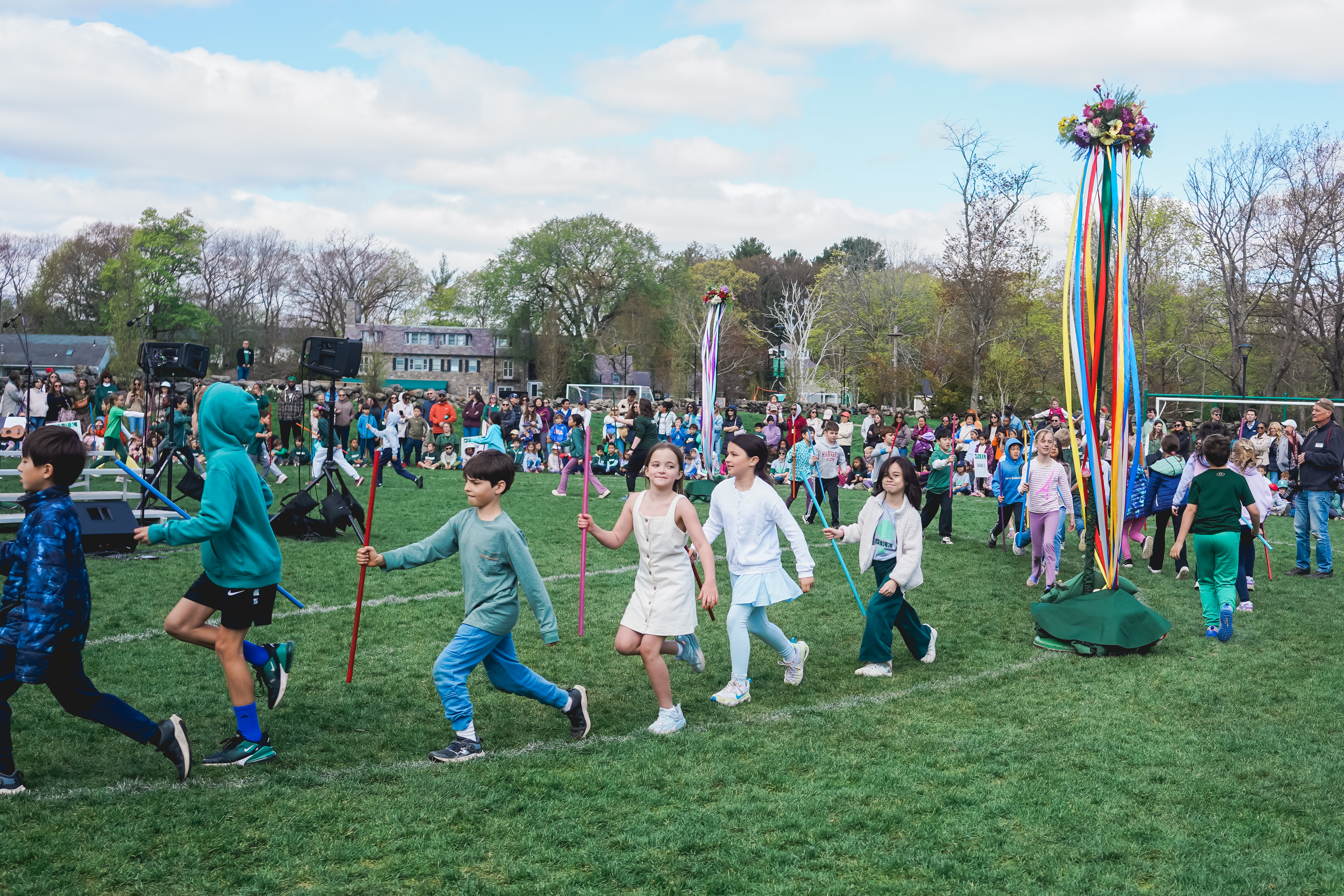
The highlight of the show was the traditional Maypole dance –the weaving of an intricate pattern of ribbons around a freestanding metal rod; and a Morris stick dance—a combination of rhythmic steps, skips, jumps, and baton taps between pairs. Grade 3, which was once the oldest class in the lower division, did the honors of both.
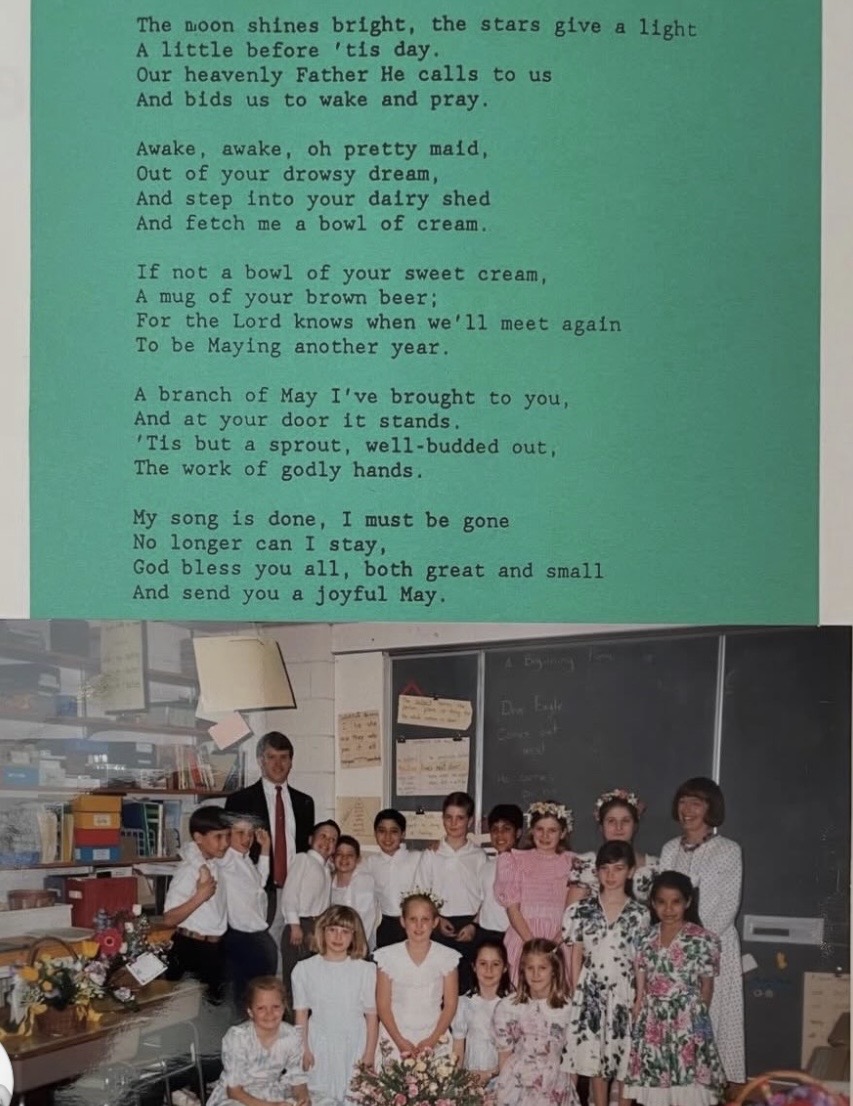
For much of its history, May Day was a formal event. Students donned floral dresses, blazers, and crisp collared shirts. They also brought in—sometimes sculpturally elaborate—flower arrangements that were incorporated into the performance and then gifted to faculty members.
Over time, the celebration has evolved into a new iteration. During the pandemic, the performance moved from the West Gym outside to Park’s vibrant, green fields. In 2023, the school introduced a service component to the festivities.
Students now spend May Day morning digging in, often literally, to improvement projects on campus. They generally sport Park T-shirts, not cotillion best, although some still opt for floral dresses. As a finale, each grade plants a tree to help forward Park’s “100 Trees in 10 Years” initiative.
“It’s a day that really goes to our motto of simplicity and sincerity,” explains Head of School Scott Young.
.JPG)
Sweet music
While May Day has in some ways become more multifaceted, the musical program has been streamlined. Rather than each grade owning a song, Grade 3 takes center stage (or center field) and leads the whole school, in three vernal tunes: the driving, “Keep on the Sunny Side,” the Scottish folk song, “Wild Mountain Thyme,” and all-around classic, “The Garden Song.”
“The kids seem to love all of them,” says Grade 3 Music teacher Michael Glashow, who notes that “Wild Mountain Thyme” is a perennial sleeper hit. “It’s a sweet song,” Michael said. “And I often expect kids to be into songs that are really upbeat, but they cheer for it.”
Overall, there is an emphasis on leadership as opposed to performance. “I talk in class about how people will be looking at them to know what to do,” Michael said. “[I tell them] it’s really important that their movements are accurate, and that they are keeping their focus so they can be relied on.”
May Day concludes, fittingly, with a flower passing ceremony, in which every Grade 3 student gives a rose to a current Grade 4 student; a changing of the guard moment, recognizing Grade 4’s graduation to the upper division.
Practice and more practice
Some May Day mainstays remain unchanged—like the dances. Park students have been clicking sticks in rhythm to a gentle piano rendition of “Lads a Bunchin’” and weaving Maypole ribbons to the jaunty, orchestral sounds of “English Folksong Suite” for decades.
“I still remember how it felt,” said alumna Abbie McKeon of her turn around the Maypole in 1992.
This year marked a full-circle moment when Abbie watched her Grade 3 daughter undertake the rite of passage. “For people with siblings or alumni parents, it’s a tradition,” she said. “There is a sense of ‘I did this.’ ‘You did this.’ It’s special.”
The stick and Maypole dances were originally choreographed to challenge and showcase older students’ locomotor, sequencing, and tracking skills.
They’re exacting routines that demand attention to detail, and their collaborative elements in some ways raise the stakes. “They have a responsibility to their classmates to get it right,” said Scott. “It’s not dissimilar to the expectations of life, but packaged differently.”
Students spend over a month rehearsing in their P.E. classes, an exercise in flexibility and patience for repetition.
“Mr. T is really good at spotting mistakes,” reports Jasper, Grade 3, in reference to P.E. teacher and veteran May Day dance instructor, Paul Toussaint. “When he spots a mistake, you have to start over again.”
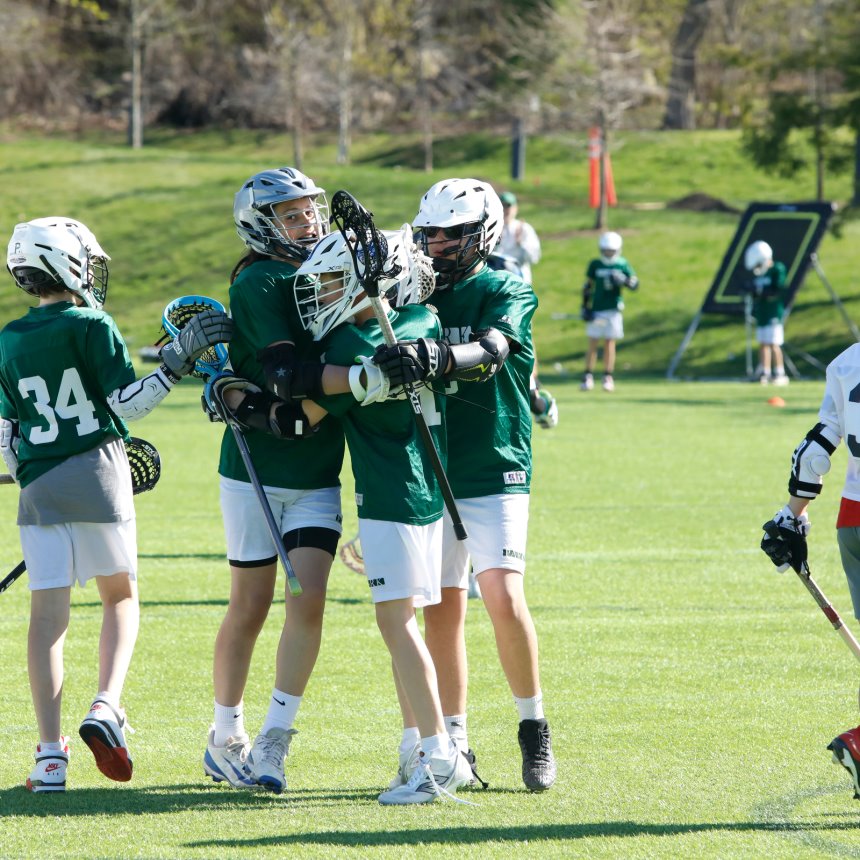
In peak May Day season, the pursuit of mastery seeps into every part of daily life. Kids enact the stick dance at lacrosse practice, hop skip in a line on their way up to ASP carpool, and mime movements while getting into their vehicles.
According to Paul, when everyone gets the hang of the steps, “You can close your eyes and hear the rhythm. That they are jumping at the same time. That they are perfectly in sync.”
Mollie Kearns, another Grade 3 P.E. teacher, says the unit often speaks to less traditionally sports-oriented students. A child who may not have thrived in, say, foot dribbling, might excel with this different type of challenge. “It’s cool to see kids get comfortable,” said Mollie. “And to see the students who get it helping other students.”
Planning to improvise
Naturally, there is built-in pressure. “It was the most nervous I ever felt in my life,” said Jasper, reflecting on his performance this year. But these nerves also offer their own opportunity.
“When I think about how students leave Park with the ability to stand before an audience to speak, to perform with composure,” said Scott. “[Events] like May Day are the stepping stones that get them there.”
Teachers also stress to students that mistakes happen and unforeseen obstacles will arise. “You have a plan sometimes, the plan can get messed up, how do we respond to that?” Mollie explains.
Abbie knows this reality firsthand. In ’92, the technology of the day, the cassette tape, malfunctioned, and the song cut out abruptly mid-program. Most years, the hiccups have been less dramatic—a surprising number of shoes lost mid-performance, a dropped ribbon, a group of kiddos heading off in the wrong direction. Every imperfection is also a chance to develop resilience.
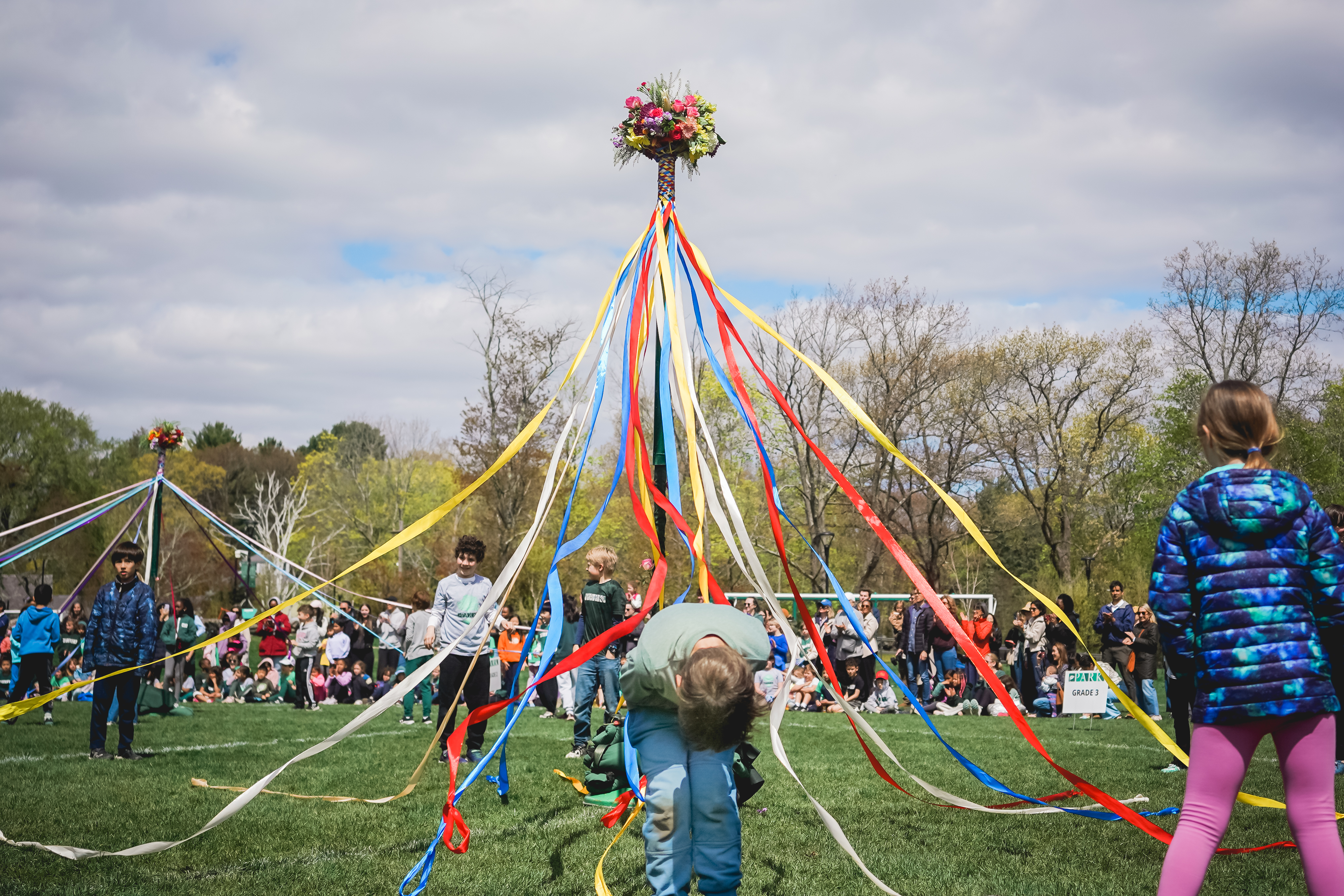
This year, it was Mother Nature that put organizers and the performers to the test. Before the Maypole dance, the wind whipped the ribbons around each other, requiring patient untangling by teachers, and even a few last-minute ribbon switcheroos between students to get everything sorted.
The event was, otherwise, seamless. Sticks clicked in time, the ribbons on the Maypole wound together in expert precision. Nary a shoe flew off. The dancers wore looks of pride and concentration, and maybe let out one or two giggles.
When it was over, Paul and Mollie gathered the grade on the field for a congratulatory huddle.
And just like that, the weeks of hard work, of memorizing, “One, two, three hop. One, two, three hop,” the anxious anticipation, had paid off.
How did it feel after the final ribbon was thread and the music done? “I felt happy,” Jasper reports. “I don’t have to keep remembering [the steps]. It’s just, like, gone out of my head. It feels good.”
By: Caitlin Rimshnick, Park Perspectives Co-Editor
#TheParkSchoolMA #ParkSchoolExcellence #ItAllStartsatPark #ParkSchoolCommunity


_11zon.jpg&command_2=resize&height_2=85 "Small Ideas that Build Something Special")